
CII Karnataka ESG Summit 2026 Calls for Shift from Sustainability Commitments to Action
The 4th CII Karnataka ESG Summit in Bengaluru brought together more than 150 CXOs, policymakers and sustainability experts to discuss climate resilience, competitive business strategies and actionable ESG practices. The summit also saw the launch of the white paper “ESG in Value Chains: From Expectations to Action,” offering practical frameworks for embedding sustainability across supplier ecosystems.
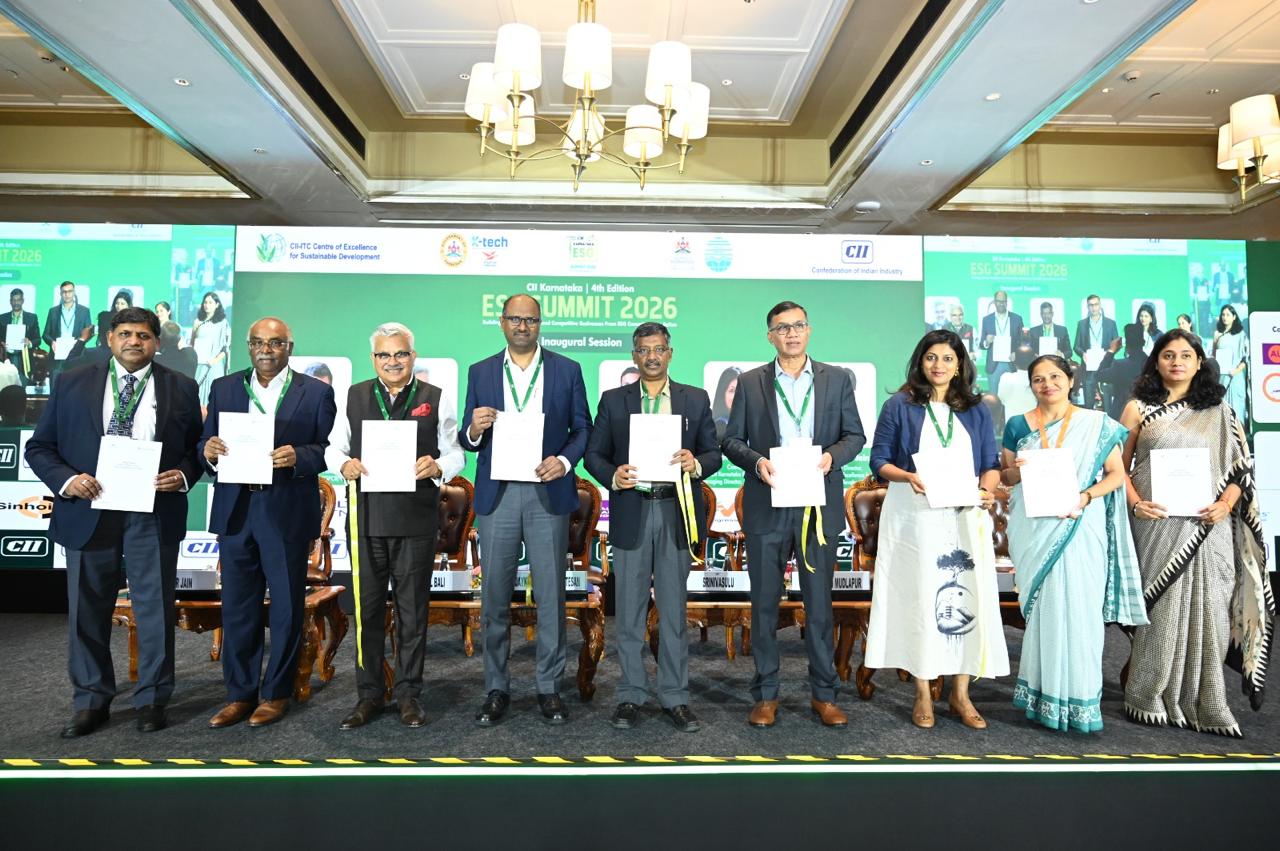
- The 4th CII Karnataka ESG Summit in Bengaluru brought together more than 150 CXOs, policymakers and sustainability experts to discuss climate resilience, competitive business strategies and actionable ESG practices.
- The summit also saw the launch of the white paper “ESG in Value Chains: From Expectations to Action,” offering practical frameworks for embedding sustainability across supplier ecosystems.
The 4th Edition of the CII Karnataka ESG Summit was held in Bengaluru on Friday, September 11, 2026, bringing together industry leaders, policymakers and environmental experts to discuss the theme, “Building Climate-Resilient and Competitive Businesses: From ESG Commitment to Action.” Organised by CII Karnataka in partnership with the CII-ITC Centre of Excellence for Sustainable Development, the summit focused on accelerating the transition from ESG commitments to concrete business action.
The conference highlighted a decisive shift in the way corporate India is approaching Environmental, Social and Governance (ESG) criteria, with sustainability increasingly being viewed not merely as a compliance requirement but as a core driver of business strategy, resilience and long-term competitiveness.
Speakers at the summit emphasised that climate change and supply chain disruptions are no longer solely environmental concerns, but increasingly pose direct risks to financial stability and corporate survival.
Shri Srinivasulu, IFS, Chairman of the Karnataka State Pollution Control Board (KSPCB), said climate-related factors must now be considered alongside traditional business inputs such as land, labour, capital and finance when companies make boardroom decisions.
Mr. Kamal Bali, Past Chairman of CII Southern Region and Managing Director of Volvo Group, stressed the need to build resilience across business operations. He highlighted geopolitical shifts, energy security concerns and technological disruptions as factors requiring resilience to be embedded across supply chains, product lines and workforce management.
Mr. Vijaykrishnan Venkatesan, Chair of the Summit and Managing Director of Kennametal India Ltd, said that while compliance with global frameworks such as GRI and BRSR remains important, businesses must embrace the broader purpose of ESG to build organisations capable of remaining sustainable and competitive for decades.
Mr. Guruprasad Mudlapur, Chairman of the CII Karnataka State Council and Managing Director of Bosch Ltd, highlighted ESG as an opportunity for businesses to unlock new markets, technologies and competitive advantages rather than viewing it solely as a mechanism for risk mitigation.
Ms. Pavitra Shankar, Convenor of the CII Karnataka ESG Panel and Managing Director of Brigade Group, called for stronger collaboration between government, industry and local communities to translate decarbonisation and human rights commitments into practical action across value chains.
A key highlight of the summit was the launch of the industry white paper titled “ESG in Value Chains: From Expectations to Action.” The publication presents practical frameworks for businesses seeking to strengthen sustainability practices across their supplier ecosystems and value chains.
The summit brought together more than 150 CXOs and senior executives. Representatives from government bodies, including the Department of Information Technology & Biotechnology (ITBT), Government of Karnataka, and the Karnataka State Pollution Control Board, participated alongside leading companies and industry organisations.
Industry representation included Brigade Group, Bosch Ltd, Kennametal India, Toyota Kirloskar Motor, AU Small Finance Bank, Bharat Fritz Werner Ltd, Maini Group, ASM Technologies, Schevaran Laboratories, N Ranga Rao & Sons, Zing HR, Kanara Consumers and Sinhoi Advisory Services, among others.
Shri Srinivasulu, IFS, Chairman of KSPCB, said climate change has evolved beyond an environmental or developmental concern to become a significant business and economic risk.
Kamal Bali said ESG is moving from aspiration towards execution, with resilience emerging as a key business imperative.
Vijaykrishnan Venkatesan said ESG is evolving from a compliance requirement into a foundation for long-term business sustainability, competitiveness and growth.
Guruprasad Mudlapur emphasised that ESG can no longer remain confined to sustainability functions and must instead be integrated into boardroom decisions and everyday business practices.
Pavitra Shankar reiterated the need to move from commitment to action by translating ESG principles into practical approaches across businesses and value chains.
Rajath Kankar
Journalist, Editor-in-Chief BHARATH INN