
Aster CMI Hospital Performs India’s First Pediatric Kidney Swap Transplant, Saves Two Lives in Bengaluru
Aster CMI Hospital, Bengaluru has successfully carried out India’s first pediatric ABO-incompatible kidney transplant through a two-way donor swap between two families. A 15-year-old boy and a 21-year-old man, who could not receive kidneys from their own family donors due to blood group mismatch, underwent life-saving transplants using tech-driven matching.
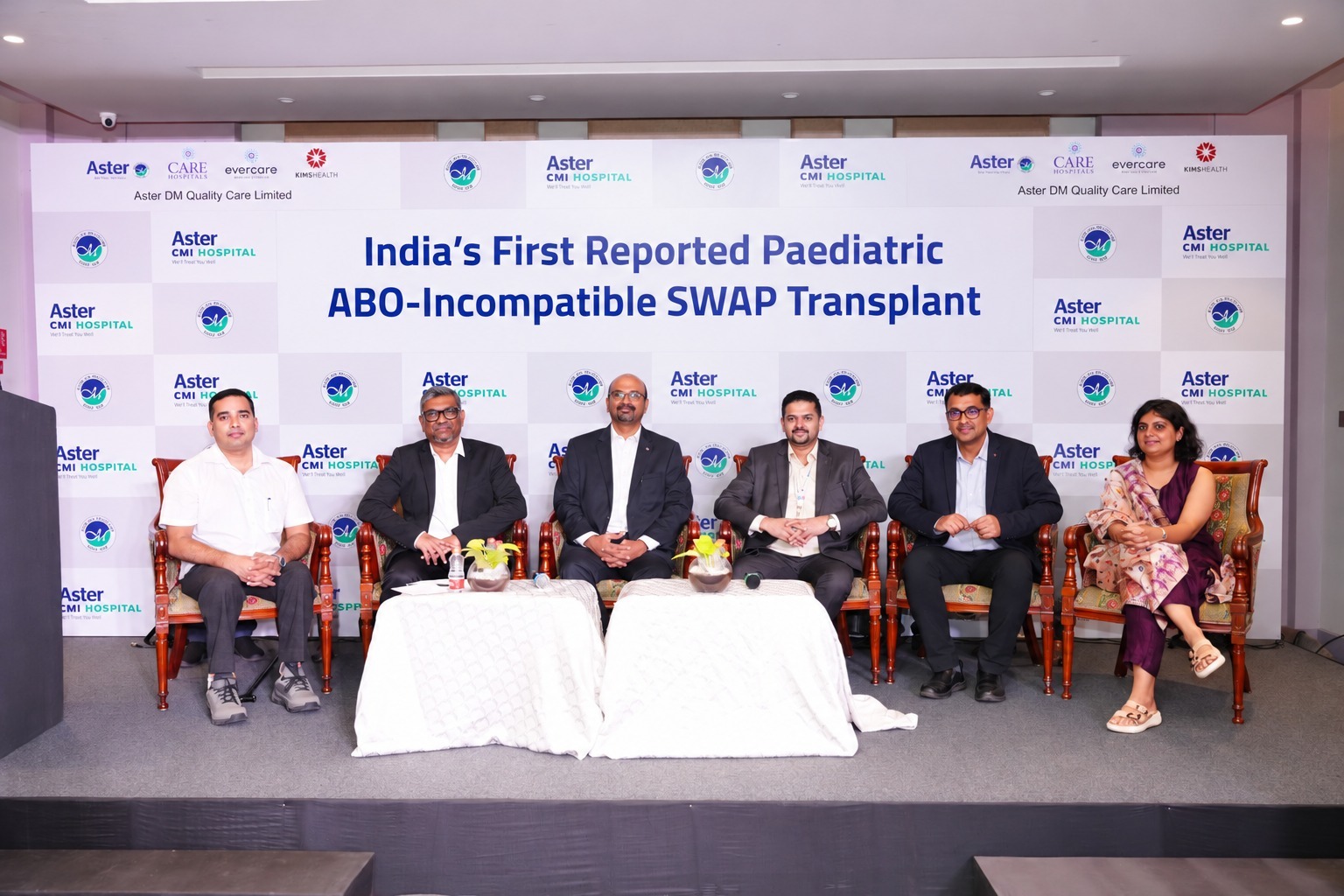
- Aster CMI Hospital, Bengaluru has successfully carried out India’s first pediatric ABO-incompatible kidney transplant through a two-way donor swap between two families.
- A 15-year-old boy and a 21-year-old man, who could not receive kidneys from their own family donors due to blood group mismatch, underwent life-saving transplants using tech-driven matching.
Aster CMI Hospital Achieves India’s First Reported Pediatric Kidney Transplant Through Donor Swap
Aster CMI Hospital in Bengaluru has reportedly achieved a significant milestone in transplant care by facilitating India’s first reported pediatric ABO-incompatible kidney transplant through a two-way kidney donor swap. The procedure enabled a 15-year-old boy and a 21-year-old man to receive life-saving kidney transplants after their respective family donors were found incompatible because of blood-group differences.
How the Kidney Donor Swap Worked
Both patients had relatives willing to donate a kidney, but direct transplantation was not possible because of blood-group incompatibility. To overcome this challenge, the hospital arranged a paired kidney exchange between the two families. The teenager received a kidney from the adult patient's family donor, while the 21-year-old man received a kidney from the teenager's family donor.
This approach, known as kidney-paired donation (KPD), allows incompatible donor-recipient pairs to exchange donors with other suitable pairs. It can create new opportunities for living-donor transplantation for patients who might otherwise be unable to receive a kidney from their willing family members.
Technology Enables Donor Matching
Aster CMI Hospital used Alliance for Paired Donation (APKD) software to identify suitable donor-recipient combinations. The technology helped the transplant team evaluate compatibility and establish an appropriate exchange between the two families.
Kidney-paired donation can help address blood-group incompatibility and certain human leukocyte antigen (HLA) mismatches. By identifying compatible combinations, matching systems can expand opportunities for transplantation. According to the hospital, the approach could reduce treatment costs by approximately 40% compared with conventional methods. Actual costs and outcomes depend on individual medical circumstances.
Months of Planning and Coordinated Surgery
The complex procedure required months of preparation and coordination among multiple medical teams. According to the hospital, the operation involved four operating theatres functioning simultaneously, supported by four anaesthetists, four transplant surgical teams and infectious disease specialists.
Dr. Arun Kumar N, Senior Consultant – Nephrology and Renal Transplant at Aster CMI Hospital, highlighted the importance of technology-assisted matching and multidisciplinary collaboration in completing the simultaneous procedures. Dr. Avinash T S, Lead Consultant – Urology, explained that paired donation provided a pathway for both patients when direct transplantation was not possible because of blood-group incompatibility.
Hospital Leadership Highlights Access to Transplant Care
Sudhindra G Bhat, Chief Operating Officer of Aster DM Quality Care, said the achievement reflected the organisation’s commitment to making advanced healthcare solutions accessible to patients with complex medical needs. He noted that paired donation could offer new possibilities to families struggling to find compatible kidney donors.
Dr. Prashant N, Regional Chief Executive Officer of Aster DM Quality Care, emphasised the growing role of technology in donor-recipient matching. He stated that kidney-paired donation could expand the living-donor pool by connecting compatible pairs that might otherwise be unable to proceed with transplantation.
Significance for Kidney Transplantation in India
The reported achievement highlights the potential of kidney-paired donation to overcome donor incompatibility and create additional transplant opportunities, including for children and young patients. Combining matching software, careful planning and coordinated surgical expertise may help eligible patients access living-donor transplantation when direct donation is not feasible.
The hospital’s reported milestone underscores the importance of expanding awareness and access to paired kidney donation. Eligibility, compatibility, potential risks and expected outcomes must be assessed individually by qualified transplant specialists.
Rajath Kankar
Journalist · BHARATHINN
